
Hidden Tree Defects & Building Risk: Why Early Arborist Assessment Matters
When planning new structures, trees are often assessed from ground level or late in the design process. This project in the Clarence Valley is a clear example of why a proper arborist assessment should come first.
Project Context
We were engaged to carry out pruning along a boundary fenceline to allow clearance for a proposed granny flat. The initial scope was straightforward and typical of many projects across Grafton and the wider Clarence Valley — selective pruning to facilitate construction.
What We Found
During works, aerial inspection revealed significant internal decay and structural compromise within the main scaffold unions of multiple trees.
These defects were:
Located high in the canopy
Not visible from ground level
Associated with previous limb failure and decay pockets
Indicative of reduced structural integrity under load or wind
From the ground, these trees appeared suitable for retention. From within the canopy, the condition told a very different story — something only identifiable through a thorough tree risk assessment by a qualified arborist.
Risk Implications for Construction
With a new structure planned directly adjacent, the presence of advanced decay in primary unions significantly increased the likelihood and consequence of failure.
In practical terms:
Retention posed an unacceptable long-term risk to the proposed granny flat
Future failure would likely result in structural damage and potential liability
Pruning alone would not adequately mitigate the underlying defects
Revised Recommendation
Based on these findings, the recommendation shifted from pruning to tree removal.
Importantly, this change occurred:
Before construction commenced
While site access was still favourable
Without delaying the broader project
Early identification allowed the client to make an informed, cost-effective decision.
Outcome for the Client
The revised approach ensured:
Long-term safety of the site
Protection of the future structure
Avoidance of significantly higher costs post-construction
This is a common outcome when engaging an experienced arborist in the Clarence Valley early in the planning process.
Why On-Site Arborist Expertise Matters
This outcome relied on having qualified professionals on site — not just carrying out a predefined scope, but actively assessing tree condition in real time.
With AQF Level 5 arborists present:
Defects were identified during works, not after
Risk was assessed immediately and accurately
Recommendations were evidence-based and defensible
This is the difference between simply completing a job and providing professional arboricultural advice and reporting.
Key Takeaway
Before investing in new builds, granny flats, or renovations, trees should be properly assessed — ideally including aerial inspection where required.
What appears acceptable from the ground can conceal significant defects.
Engaging a qualified arborist early helps:
Inform site design and layout
Avoid costly redesign or rework
Reduce long-term risk and liability
If you’re planning construction in Grafton, Clarence Valley or Coffs Harbour, arranging a professional tree risk assessment or arboricultural report early in the process can prevent costly surprises and ensure your site is safe and construction-ready.
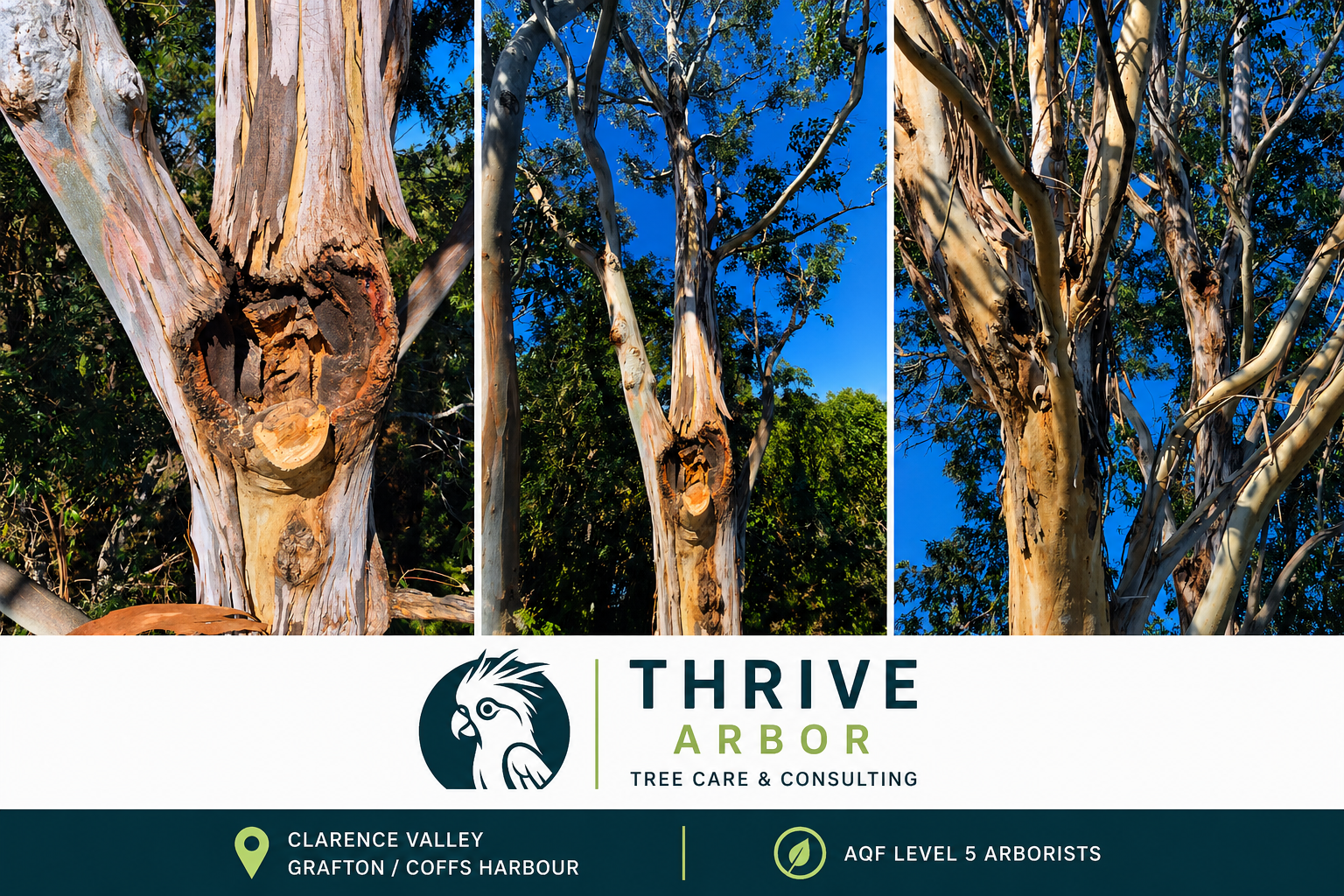
Defects found at 15m up in the canopy of these gum trees